

Time: 2025-12-02
Views: 252

[Foreword]
Decision has been deeply involved in the SAP field for more than 19 years and has been praised by many customers. In order to better help customers implement digital projects, the "Decision Expert Column" is completely free and open source, paying tribute to Musk's open source spirit!
Based on the senior capabilities of Decision's expert consultant team with more than 20 years of SAP experience, combined with Decision's 1,000+ successful project cases, this article summarizes and publishes the corresponding research experience and suggestions of enterprises in promoting ERP project implementation, and continues to escort the SAP implementation and delivery of enterprises.
[Problem Description]
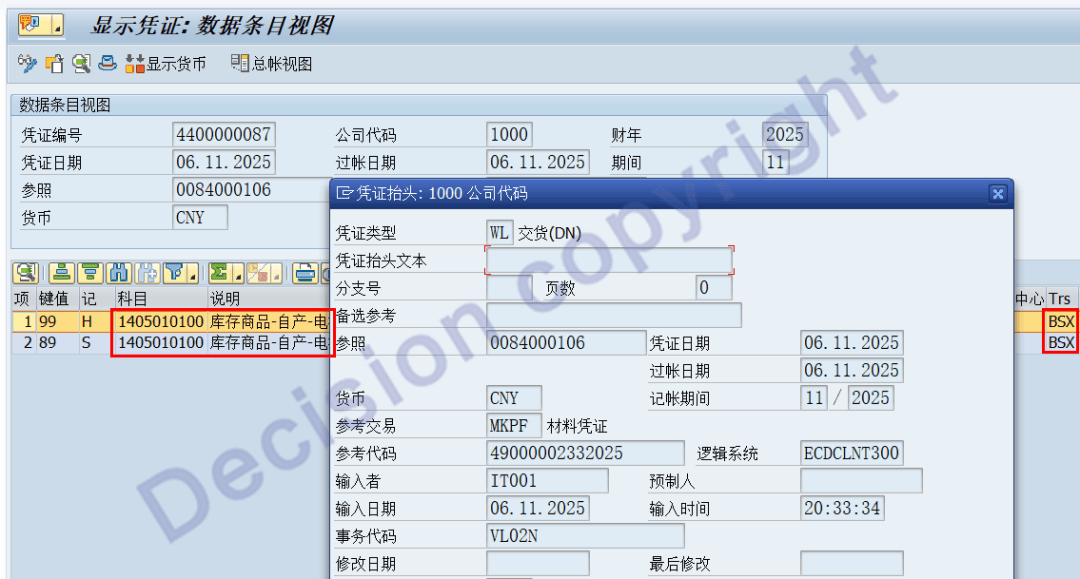
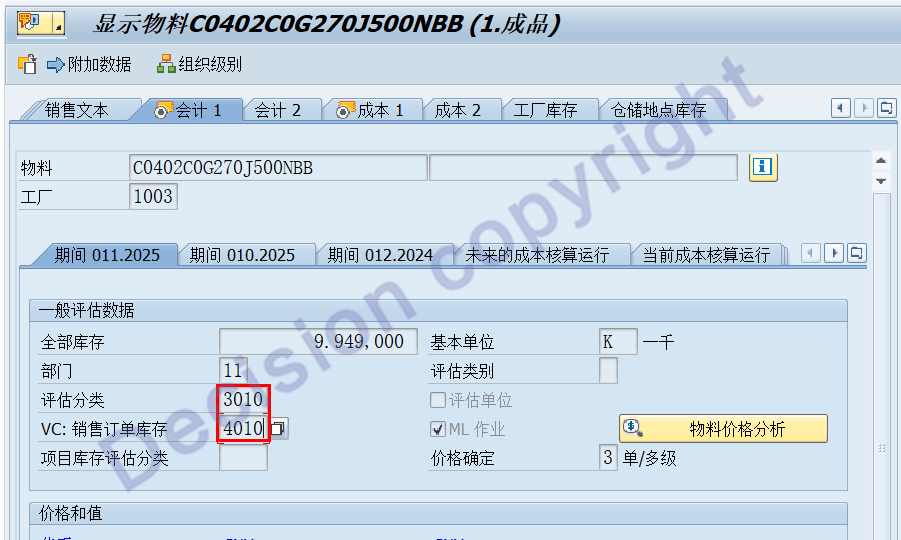
The SIT (Sales Invoice to Inventory) function is already enabled in the system. Transaction code VL02N (Sales Outbound) first transfers the goods to T (T Inventory) for shipment, and transaction code VLPOD (Sales Delivery Confirmation) transfers the cost of goods sold. Why, in the master database, even though the corresponding valuation class 4010 (Goods Issued) and delivery note 84000106 (Sales Outbound) have been maintained, is the T Inventory amount not posted to the goods issued?

MM03 Master Data: Evaluation Class.

[Problem Analysis]
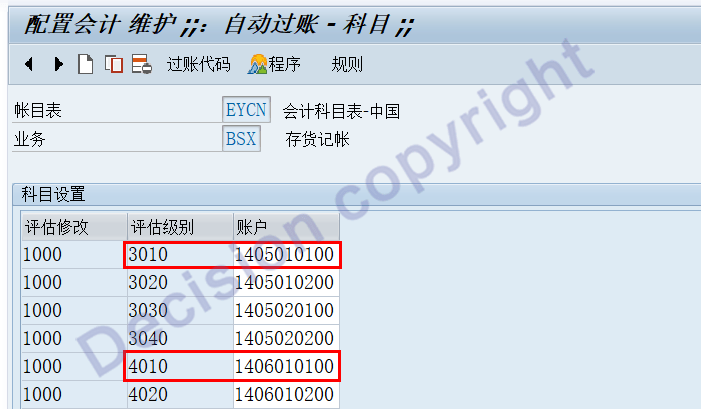
1. Transaction code OBYC reveals the BSX configuration:
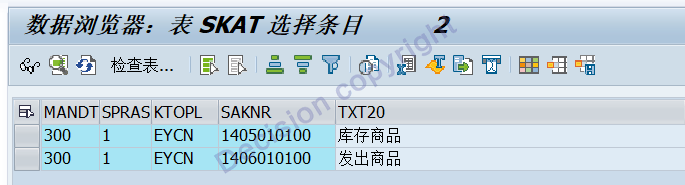
3010 -> 1405010100 Inventory Items
4010 -> 1406010100 Issued Items


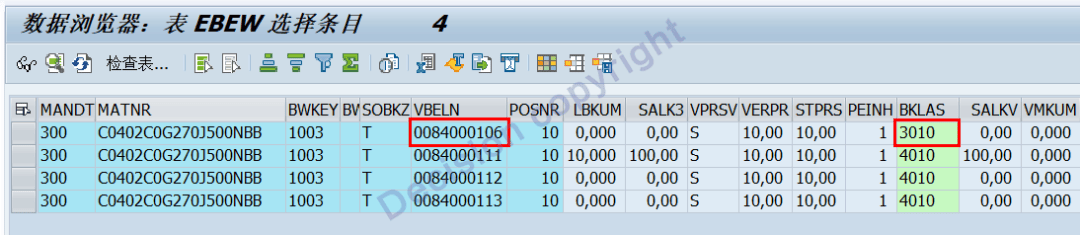
2. Use transaction code SE16 to view the data table EBEW.

As you can see, in delivery note 84000106, line item 10, material: C0402C0G270J500NBB, the corresponding evaluation class is 3010.
3. Summary:
① The valuation class displayed by transaction code MM03 is the valuation class in the MBEW table.
② For E and T inventory, the system reads the valuation class from the EBEW table.
③ When the first E and T inventory receipts occur, the system reads data from the MBEW table to create the EBEW table. At the time of creation, the sales order valuation class in transaction code MM03 was not updated in time, so the system reads the ordinary inventory valuation class as the valuation class for the T inventory and stores it in EBEW.
④ Subsequent modifications to the valuation class in transaction code MM02 only apply to E and T inventory records created after the initial transaction. They do not apply to inventory records already created in the EBEW table.
⑤ The material master data valuation class must be correctly maintained the first time! Subsequent modifications require clearing the original E and T inventory records and creating a new delivery note or sales order for the sale to proceed. Only then will the system store the correct valuation class in EBEW.
⑥ As of now, SAP does not have the function to modify E-inventory and T-inventory valuations. It is still possible to clear the inventory, recreate the document and process the outbound shipment as described above.
[Solution]
1. For material master data valuation classes, the initial maintenance must be correct! Subsequent modifications require clearing the original E and T inventory levels, creating a new delivery note or sales order, and re-issuing the goods. Only then will the system store the correct valuation class in EBEW.
2. To prevent errors in maintaining E and T inventory valuation classes in the master data, you can refer to the "Issued Goods SIT Inventory Valuation Classes" for enhancements to automatically match the appropriate valuation class.
【Service Guide】
For more information on SAP courses, project consultation and operation and maintenance, please call Decision's official consultation hotline: 400-600-8756

【About Decision】
Global professional consulting, technology and training service provider, SAP gold partner, SAP software partner, SAP implementation partner, SAP official authorized training center. Nineteen years of quality, trustworthy!